
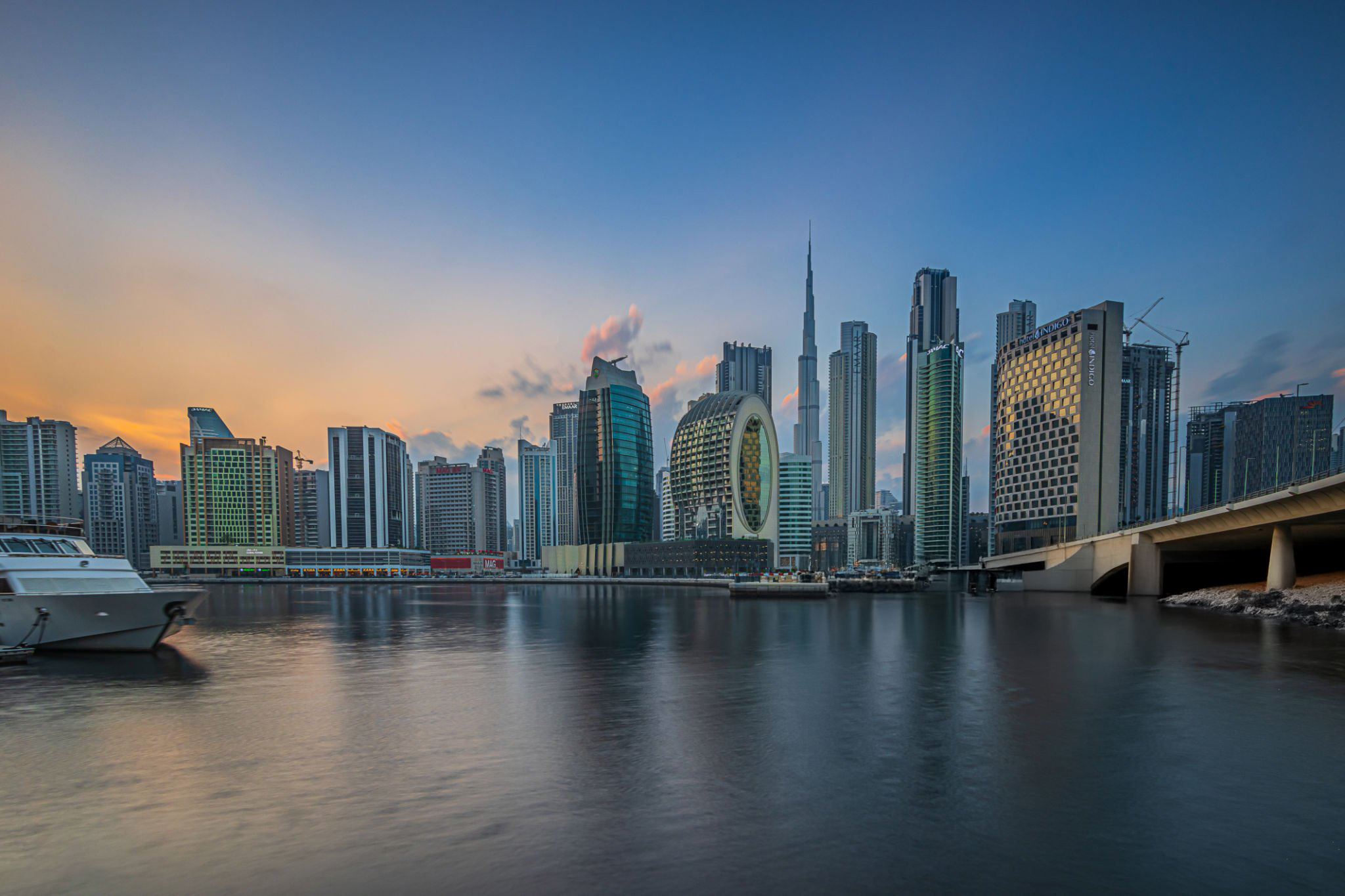
Across the globe, governments and private-sector innovators are racing to define the next generation of cities—smarter, more sustainable, and built to compete in a technology-driven economy. Yet no region is moving faster or with more ambition than the Middle East. The GCC has become a unique place where bold urban ideas are designed and deployed at a pace few places can match.
The GCC smart cities and digital transformation market is projected to surge from $145.5 billion in 2024 to $907 billion by 2032.[i] In 2024 alone, GCC governments announced more than $67 billion in new public-private digital transformation investments — one of the largest single-year smart infrastructure build-outs on the planet.[ii] With deep capital reserves, decisive leadership and a culture that embraces experimentation, the region is building tomorrow’s city models, and setting global trends for the decades ahead.
Megaprojects as living R&D labs.
The region’s mega projects- NEOM, Masdar City, Expo City Dubai, and Lusail City, are large-scale prototypes for future living. NEOM is developing AI-driven “cognitive city” systems and advancing renewable energy such as green hydrogen. Masdar is pioneering sustainable urban design. Expo City turned a world’s fair site into a circular economy hub, and Lusail in Qatar is wiring an entire new city with smart grids and offering mobility-as-a-service from day one. Unlike mature cities weighed down by legacy infrastructure and slow processes, these projects can roll out next-gen solutions from the ground up without the same constraints.
Essentially, these mega projects function as collaborative innovation zones or ‘living labs,’ where governments, global corporations, and startups run real time experiments, gather data, and fine tune approaches under controlled real-world conditions.
Digitalization is changing the math of real estate
In the Middle East, the digital layer of a future-ready building is now just as important as the glass and concrete that shape it. Proptech adoption—spanning AI-driven facilities management, blockchain land registries, smart grids, and predictive water systems, is accelerating across the region and redefining what real estate can do. Buildings are no longer static assets, but are continuously optimizing, data generating platforms.
This shift means a single square meter now earns in two ways: traditional rent or lease on the physical space, and new recurring revenue streams, such as subscription amenities, usage-based services, and even data-as-a-service. Leading this transformation, the GCC is demonstrating how real estate delivers greater value when its digital and physical layers create new financial returns. Investors aren’t just buying a building; they’re buying a cash-flowing digital structure that is sustainable and resilient.
Mobility is the New Skyline
The GCC is pushing the boundaries of technology, sustainability and design in transportation, redefining how people move. Cities are deploying AI- powered traffic systems that predict congestion and adjust traffic signals dynamically, cutting delays, improving emergency response times, and reducing violations. Autonomous shuttles and on-demand electric transit are being integrated into the region’s mega projects as well as new planned communities. Some countries are even exploring ultra-high speed hyperloop systems, including the recently announced “Dubai Loop.”
Dubai has also completed successful tests on air taxis capable of carrying 4 passengers, with plans to launch service by 2026.
With rapid population growth in the region, these smart mobility solutions not only provide cleaner air, more free time, and safer roads for residents, but also help cities operate more efficiently, strengthening local economies.
Cities that attract talent and capital
National initiatives like UAE Vision 2031, Saudi Vision 2030, and Qatar National Vision 2030, are central to long- term economic diversification, using future-city projects to reduce reliance on oil, attract global talent, and draw in investment capital. Incentives like Golden Visas, along with business- friendly regulatory sandboxes, special economic zones with tax breaks, and government backed accelerators help startups to go from seed to scale far more quickly.
The economic potential drives job creation, drawing in founders, engineers, and investors into innovation zones, which in turn attract more startups and more businesses, including multinational corporations. Together, these dynamics position the region not merely as a place to do business, but as one of the world’s most competitive places for innovation driven economic growth.
Why global capital is pouring in
The Middle East is experiencing a sharp rise in foreign investment inflows. In Q1 2025, Saudi Arabia recorded $5.9B—a 44% increase year-over-year, while the UAE drew $45.6 billion in capital in 2024, up 48.7% from the previous year.[iii]
Investors are more confident in the region because GCC smart city mega projects are platforms where unprecedented innovations are being tested, analyzed and tweaked using real-time data at a level few places can match. As a result, experimentation risk drops, and the path from pilot to full commercialization becomes much straighter and predictable. Once the next-gen models prove viable in the Gulf cities, they can be scaled to markets around the world.
Where Tomorrow’s Cities Take Shape
The Middle East is outpacing the world in building the template for tomorrow’s global cities. For entrepreneurs, investors and deal-makers, the time is right to engage now, while the standards are still being written and there is still opportunity to shape the transformation. The breakthroughs happening here will not only redefine skylines, but set new global expectations of how cities are designed, operated, and lived for years to come.
[i] Goel, M. (July 7, 2025). GCC Smart Cities and Digital Transformation Report. Data M Intelligence. https://www.datamintelligence.com/research-report/gcc-smart-cities-and-digital-transformation-market
[ii] Goel, M. GCC Smart Cities and Digital Transformation Report.
[iii] Argaam. (June 9, 2025). Saudi Arabia’s FDI reaches SAR 22.2B in Q1 2025.
https://www.argaam.com/en/article/articledetail/id/1824200 ;
UAE Ministry of Investment. (June 26, 2025). UAE Foreign Direct Investment Report 2025
BIO—Aysha Turgut is an international speaker and strategic advisor. www.linkedin.com/ayshaturgut
