
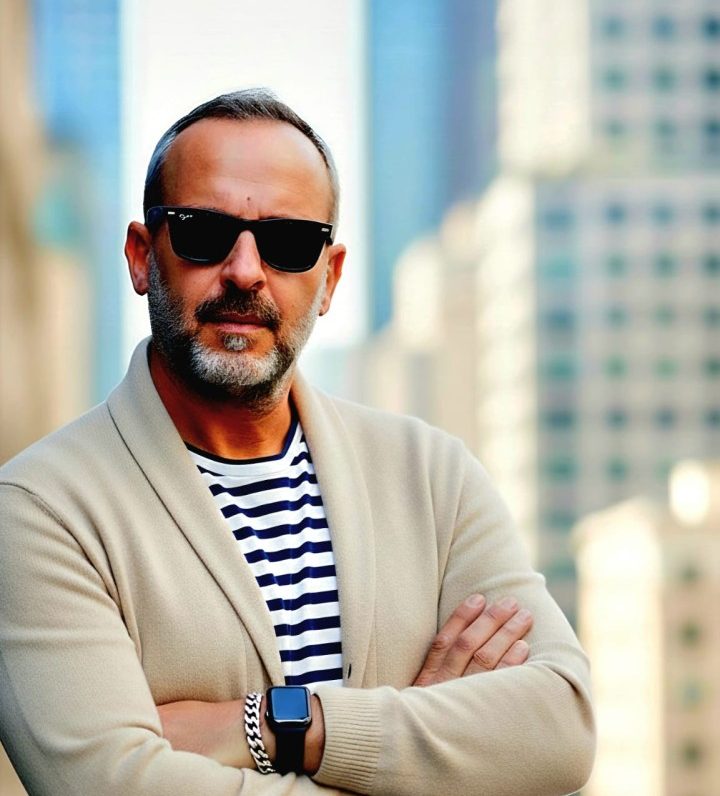
Tell us about yourself and your background and career journey.
My career has always been driven by one obsession: making complexity invisible. Luxury hospitality demands exactly that — the client should never sense the machinery behind their experience.
In 2014 I moved to Dubai and Abu Dhabi, the most unforgiving proving grounds for anyone serious about the UHNWI market. It was there I understood what institutional investors and discerning clients truly value: not opulence, not labels — the complete absence of friction, and the certainty that every detail has been handled before they think to ask.
From that foundation I founded ALMAS Hospitality Lifestyle & Consulting FZC — a fully integrated institutional platform for luxury hospitality asset governance. ALMAS is the professional core of everything I do: taking assets from land origination to stabilised exit under one governance framework, with one accountable interface and one P&L. Separately, I maintain a personal activity as a certified Fora Travel Advisor — a practice that keeps me inside the world’s finest properties as a client, not as an inspector, and sharpens the market intelligence I bring to ALMAS mandates. The two are distinct. ALMAS is the institution. Fora Travel is the lens.
How did you discover your passion and turn it into your career as a Luxury Travel Advisor?
It was a deliberate choice, not a career pivot. My primary work has always been institutional — developing, advising, and governing luxury hospitality assets. The Fora Travel certification came later, as a discipline I chose to maintain because it forces me to experience properties as the final client does: with real expectations, real money, and no professional courtesy.
That perspective is invaluable. Most development advisors have never actually stayed in the assets they recommend. I have — repeatedly, as a paying client with demanding standards. The intelligence that generates flows directly into how I assess and advise on assets at the ALMAS level. But to be clear: bespoke travel design is a passion I maintain on the side. ALMAS Hospitality is my profession.
“The finest luxury is never having to think about logistics. If the client notices your effort, you have already failed.”
How is your approach as a Luxury Travel Advisor unique?
Because I am not primarily a travel advisor — I am an institutional hospitality developer who also designs travel experiences. That asymmetry is the advantage. I evaluate properties through the same Sensory Engineering™ framework I apply to asset development: spatial sequencing, acoustic design, material quality, sensory layering. When I curate an itinerary, I am not working from a preferred partner list. I am drawing on direct knowledge of what makes a property genuinely exceptional versus technically five-star but experientially hollow.
Who do you work with?
At ALMAS: institutional investors, sovereign-adjacent family offices, private developers with assets in the UAE and GCC, and international capital — European and Asian — seeking a trusted single interface into the UAE hospitality landscape. These are clients deploying serious capital who need a governance partner, not just an advisor.
For Fora Travel: a small, selective group of UHNWI individuals who want travel designed with the same precision I apply to institutional work. There is no overlap in the offer — but the intelligence compounds in both directions.
How are you revolutionising the way people approach travel — for example, through the four principles of Luxury Travel Curation?
The shift I bring — even in my travel practice — is the application of institutional thinking to personal experience. UHNWI travellers have stayed everywhere. What they seek now is not another impressive property but the feeling that an experience was designed specifically for how they want to live.
The four principles I apply: frictionlessness — the complete elimination of logistical effort; sensory coherence — every element of the experience speaking the same language; anticipatory service — knowing what the client needs before they articulate it; and narrative continuity — an experience with an intentional arc, not just a sequence of impressive moments. These are the same principles that inform how I advise asset owners to think about the guest journey at the development stage.
What are the main benefits of booking and planning a trip with you?
Access to intelligence that does not exist in any consumer channel. Because I operate at the institutional level of this industry, I know what is genuinely exceptional about a property and what is marketing. I know which operators are driving real service culture and which are coasting on brand reputation. For the clients I take on through Fora Travel, that intelligence translates directly into experiences that cannot be replicated by booking through any other channel.
You are also the Founder of ALMAS Hospitality. Tell us more about your venture.
ALMAS was founded to solve the single greatest destroyer of value in luxury hospitality development: structural fragmentation. A $200 million branded asset typically involves eight or more vendors — architect, contractor, operator, FF&E procurement — all with different incentives, different timelines, different definitions of success. The architect optimises for aesthetics. The contractor optimises for margin. The operator arrives late and finds a building never designed around operational reality. The investor watches their return erode at every handover gap.
ALMAS corrects this at the structural level. The platform integrates strategy, design, development, and execution under one governance framework — one interface, one P&L, one contractual anchor from land assessment to stabilised exit. Every partner — TARCOZ for development leadership, NPrieto Studio for design, STARASA for FF&E procurement — is compensated based on asset outcomes, not billable hours. Everyone carries a stake in the final result.
We are currently active in Ras Al Khaimah and Marjan Island — deliberately. Dubai is mature and expensive. RAK represents exactly the conditions that favour what ALMAS does: genuine government momentum, land availability, and a development pipeline where the governance premium is most visible. Our direct regulatory presence and RAKEZ relationships there are a structural advantage that compounds with every mandate we execute.
“Accountability without skin in the game is not accountability at all.”
What is your philosophy? What are your core values as a company?
Precision over volume. Accountability over advice. Outcome over process.
ALMAS operates under a sole-signatory governance model: every engagement is anchored to one accountable decision-maker from day one. No committees, no diffused responsibility, no handover gaps where accountability dissolves. For institutional capital deploying at scale, that is an extraordinarily rare offer. The market is full of advisors who will tell you what to do. It is almost entirely empty of platforms that will actually do it.
What is your mission as a company?
To close the gap between what gets promised to investors and what guests actually experience — and to prove that integrated governance produces measurably superior returns. The 28 to 45 percent price premium documented across branded residence projects where Sensory Engineering™ was applied in full is not a marketing claim. It is the financial proof of what accountability at scale looks like.
Sensory Engineering™ is exclusively held by me as CSOO — it is not licensed, not replicated across other platforms. It is the intellectual core of what ALMAS delivers, translating an investment thesis into a quantified, governed guest experience from concept through to opening day.
What is your methodology for transforming underperforming properties into high-value luxury destinations?
The diagnosis always begins in the same place: the gap between what was promised at the investment stage and what the guest actually experiences. In almost every underperforming asset I have assessed, the root cause is sequential, not physical. The hospitality vision was treated as a finishing layer rather than the architecture.
Sensory Engineering™ is the corrective framework, operating across four dimensions: spatial sequencing — how the body moves through the space; material selection — the tactile and visual language that communicates value before a word is spoken; acoustic design — one of the most underestimated levers in luxury hospitality; and sensory layering — the orchestration of all elements into an experience that feels inevitable.
In practice this means a structured audit followed by a phased intervention plan that protects revenue continuity while the asset is repositioned. The goal is not renovation — it is recalibration. When done properly, the asset does not just improve. It enters an entirely different competitive set.
“The hospitality vision is not a finishing layer. It is the architecture. Get the sequence wrong and no amount of marble will save you.”
How do you plan to grow the company over the next decade?
The model scales with extraordinary operating leverage — it does not require linear headcount growth. Near term: executing the right mandates in the UAE with the discipline that builds the track record. A single well-documented exit is worth more than ten loosely managed engagements.
Medium term: geographic expansion into Portugal, Montenegro, Oman, and KSA — markets where the premium for integrated governance is equally significant and where ALMAS has natural entry points. And beyond that: a co-investment platform, where ALMAS is not just the governance partner but a co-investor in the assets we deliver. Full alignment between our interests and the ownership structure, from origination to exit.
What is next for you?
Deepening the ALMAS mandate pipeline in RAK and Marjan Island, and continuing to build the institutional track record that opens the next phase of geographic expansion. Every well-executed mandate compounds the platform’s credibility and access.
And maintaining the discipline that I believe is the most underestimated competitive advantage in this business: knowing what to say no to. The platform gets stronger every time it declines an engagement that does not meet the standard.
“A high-quality pipeline says no more than it says yes. That is not caution. That is precision.”
Where can readers connect with you and find out more?
Visit almashospitality.com or fabriziomarraofficial.com, or reach me at info@almashospitality.com and +971 50 411 9182. On LinkedIn: Fabrizio Alfredo Marra Mentola.
