
New research data from The Trade Desk highlights a major shift in media consumption patterns surrounding live sport and global tournaments
—
As the road to the 2026 World Cup accelerates, brands across the GCC have the opportunity to rethink sports marketing and engage highly intentional audiences through omnichannel strategies built for modern sports fandom. With exceptional live sports viewership across the region at 84% in the UAE and 81% in Saudi Arabia, the World Cup represents a major opportunity for advertisers to connect with deeply engaged audiences at scale.
Global sporting events have always attracted advertisers, but the playbook around major sporting events has fundamentally changed. Fandom is increasingly complex. What was once dominated by fixed sponsorships, broad-reach television campaigns and gatherings around a single screen at a single moment in time, is now becoming a dynamic, real-time advertising ecosystem powered by connected TV (CTV), digital audio, mobile, retail media and programmatic digital out-of-home (DOOH). To cut through and be relevant in the moments that matter, brands need a deep understanding of what fans seek, at what stages of the engagement lifecycle, and which media channels best deliver those experiences.
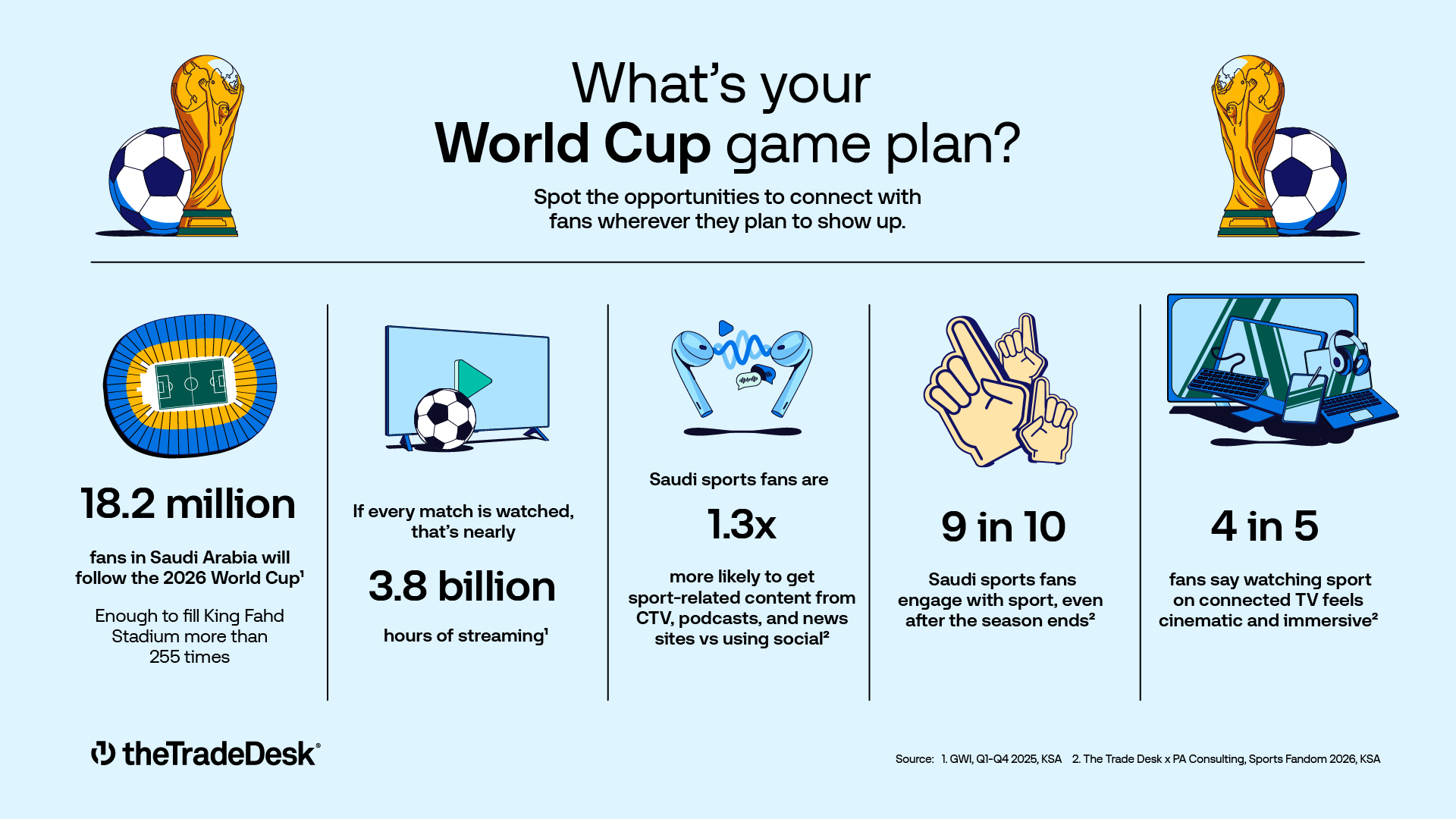
This shift is very visible in the GCC. In Saudi Arabia alone, 18.2 million fans are expected to follow the 2026 World Cup, enough to fill King Fahd Stadium more than 255 times. If every match were watched in full, it would amount to nearly 3.8 billion hours of streaming content, equivalent to more than 431,000 years of viewing time. For advertisers, the scale is significant. But the real value lies in how audiences engage.
Saudi sports fans are 1.3 times more likely to use connected digital channels over social media, highlighting a shift toward premium, immersive and cross-platform viewing behaviours. Meanwhile, nine in ten Saudi sports fans remain engaged with sport even outside tournament periods, creating opportunities for brands to build sustained relationships rather than short-term spikes in visibility.
Rather than relying solely on broad reach or social media, advertisers should think about how to connect audiences across the open internet, from premium streaming environments and live sports content to audio, mobile and retail touchpoints that reinforce messaging throughout the customer journey.
CTV is the new stadium
CTV is becoming central to that experience as the anchor of fandom. With 82 percent CTV penetration in the UAE, and four in five Saudi sports fans saying CTV makes watching sport feel more cinematic and immersive, the channel is reinforcing its growing role as the anchor of live sports engagement. CTV puts fans back in control, allowing fandom to flex around their lifestyle; they can tune in live to watch a game unfold or catch up with highlights another day. It also brings them closer to the action with CTV’s large‑scale, cinematic format that immerses fans, making them feel a part of the crowd.
This evolution matters because attention during major tournaments is both highly emotional and highly intentional. Fans actively choose where, when and how they consume content. The brands that succeed will be those that plan with the same level of precision.
Audio keeps fans connected between screens
At the same time, digital audio and podcasts are becoming increasingly important companion channels around live sport, extending fan engagement beyond the screen into commutes, gyms and everyday moments where audiences remain highly attentive and emotionally connected. Streamed audio excels at connecting fans with the personalities, emotions and stories fans crave beyond the live action. Hearing from experts and players themselves heightens fandom. Omnichannel World Cup campaigns that incorporate digital audio can access 18M+ sports fans across the UAE and Saudi Arabia alone, making it a very powerful channel.
DOOH brings fandom into the physical world
DOOH is also emerging as a critical performance layer in the region, particularly in Saudi Arabia, with fan experiences extending beyond homes into malls, promenades, transit hubs and entertainment districts. DOOH brings the stadium effect across cities, malls and transit hubs and builds buzz around big events, creating a sense of momentum and shared experience.
This matters because sporting events like the World Cup create a rare concentration of attention, intent and commerce across multiple touchpoints simultaneously. Today’s sports fan moves fluidly between screens, platforms and physical environments. Media strategies need to do the same. The opportunity lies in connecting the full fan journey across CTV, streaming audio, DOOH and commerce environments with measurement that shows what truly drove outcomes.
You don’t win by shouting louder. You win by showing up at the exact moment intent spikes.
As the GCC continues to establish itself as one of the world’s fastest-growing digital advertising markets, major sporting events like the World Cup are proving grounds for how brands can use data-driven omnichannel strategies to turn fandom into measurable business outcomes.
Importantly, brands no longer need official sponsorship status to compete for attention. Major regional companies including Qatar Airways, Saudi Aramco and Visit Saudi have already demonstrated how Middle Eastern brands can use global sporting platforms to build international visibility. But modern programmatic advertising is also creating opportunities for non-sponsors to participate intelligently through contextual targeting, agile media buying and measurable omnichannel campaigns.
The brands that win around the World Cup are the ones that capture fans across every touchpoint and show up as the exact moment intent spikes through omnichannel strategies designed to engage audience in real time, adapt to changing moments, and turn fandom into measurable business impact. Or simply put: fandom is deliberate, dedicated and always on. Advertising around it should be too.
About the research
Sports fandom methodology:
This research was commissioned by The Trade Desk and conducted by PA Consulting.
It includes a 15‑minute quantitative online survey of 2,800+ sports fans across the UK, France, Germany, Spain, Italy and Saudi Arabia, examining how different media channels are used across the sports fandom journey. This was complemented by a four‑day remote qualitative diary with 35 participants in the UK and Germany, capturing in‑the‑moment media usage before, during and after live sports events.
Sports fans are defined as people who follow sport and engage with sports content at least once every two weeks. Avid sports fans engage with sport across at least two media channels on a weekly basis.
World Cup methodology:
This research was conducted by The Trade Desk in partnership with Appinio, which surveyed 500 UK sports fans. Unless otherwise specified, all results reflect the proprietary research conducted by the Trade Desk and Appinio. This information is provided solely for background and is not a representation or guarantee of any future performance.
